I have been out-of-pocket for the last week attending trade shows and garden conferences. Normally I just share things about the plants in the city containers or beds, but I just had to share these photos with you. They made me either giggle or sigh in awe. Hope they give you some pleasure too.
This vignette was done by my favorite ground cover nursery, Evergreen (sorry, wholesale only). They have a very talented designer who comes up with something different each year for the trade show. Not saying that you should take your old toilet and place it in the front yard, but isn't this a clever idea for a casual setting.
While the toilet may not be as desirable for a container, this sink could easily fit in amongst low growing shrubs....and hey, it has its own drainage hole.
Now I have to share a couple pictures from the conference I attended at Callaway. Looking for vertical gardens I found these in the Sibley Horticultural Center. How easy can gardening get? You might not have the option for vertically stacked stone walls like this, but there is no reason that any stone wall needs to be "bare".
The Flapjack kalanchoe is not hardy in zone 8 but there are lots of sedums and echeveria that could work.
How easily this sedum and rosemary drape over this wall. And they prefer drier conditions!
Got lots of good ideas at these conferences and hope to showcase them in the summer containers.....stay tuned!
Wednesday, January 30, 2013
Tuesday, January 22, 2013
Parade of Pansies -- and Violas
I really should have titled this "Parade of Violas" because there are way more violas than pansies -- but "Parade of Pansies" had such a nice ring to it. So anyway.....let's take a look at some of them. And I say "some" because there are so many different varieties that you would get bored reading about them in one sitting. So, I'm going to spread them out over the next few blogs. Hopefully, you will find a few that you like for next year, because there isn't much left out there to buy now except for the same ole same ole. As I go through the season I'll let you know which ones did the best so keep checking in. But I'm going to start with the all time winner and one that I use over and over -- Sorbet Lemon Chiffon Viola.
This dainty looking little flower makes such an impact because it creates an 8"x8" mound covered in blooms -- all season -- and it doesn't get poutty with freezing temperatures and handles the heat just as well, so you will be able to enjoy them for a long time. I plant them shoulder to shoulder in the containers for a quick impact and they have never complained.
A new favorite for this year -- and I may like it more for its name than anything -- is Penny Marlies viola. The subtle purple and gold colors are so rich looking; and this viola always looks as though it isn't in a hurry -- just gonna hang out here and grow pretty.
Like all violas, Marlies will stay compact and handle the cold well -- and oh yeah -- just be pretty.
Let's jump over to a couple pansies for contrast. The reds don't usually draw me to their table but I do like Panola Fire. It had a 'sassy" look that I thought would go well with some fine leafed companions.
It has been doing well in the containers and not "melting" like some of the other pansies have done on these cold days. The red/yellow combination is just bright enough to catch your eye -- not getting lost in green foliage.
In contract to the sassy look of Panola Fire is a really sweet pink pansy called Nature Frosty Rose.
I do love this one but I have to admit it doesn't like partial shade and is stretching a bit; but it seems to be working well with the companion plants to give the whole container an "airy" look.
You are probably asking why I put pansies in partial shade. Not much choice with containers in the town: tall trees, tall buildings, short days -- but I wanted to add some color so we are taking what we get.
Need to make a point about the names of these pansies and violas. Sorbet, Penny, Panola, and Nature are all a series of plants from a grower; so there will be lots of others with that as their first name. If you find you like that series, check the website for more and you will find lots of different colors.
So, that's probably enough for today. Many more to talk about so check in again real soon. Well, not too soon -- I'm headed to a trade show and a conference this week to find more great plants for the summer containers. Be back "sorta soon".
Wednesday, January 9, 2013
A Rose in January - 'Old Blush' - Its Friend 'Pink Frost'
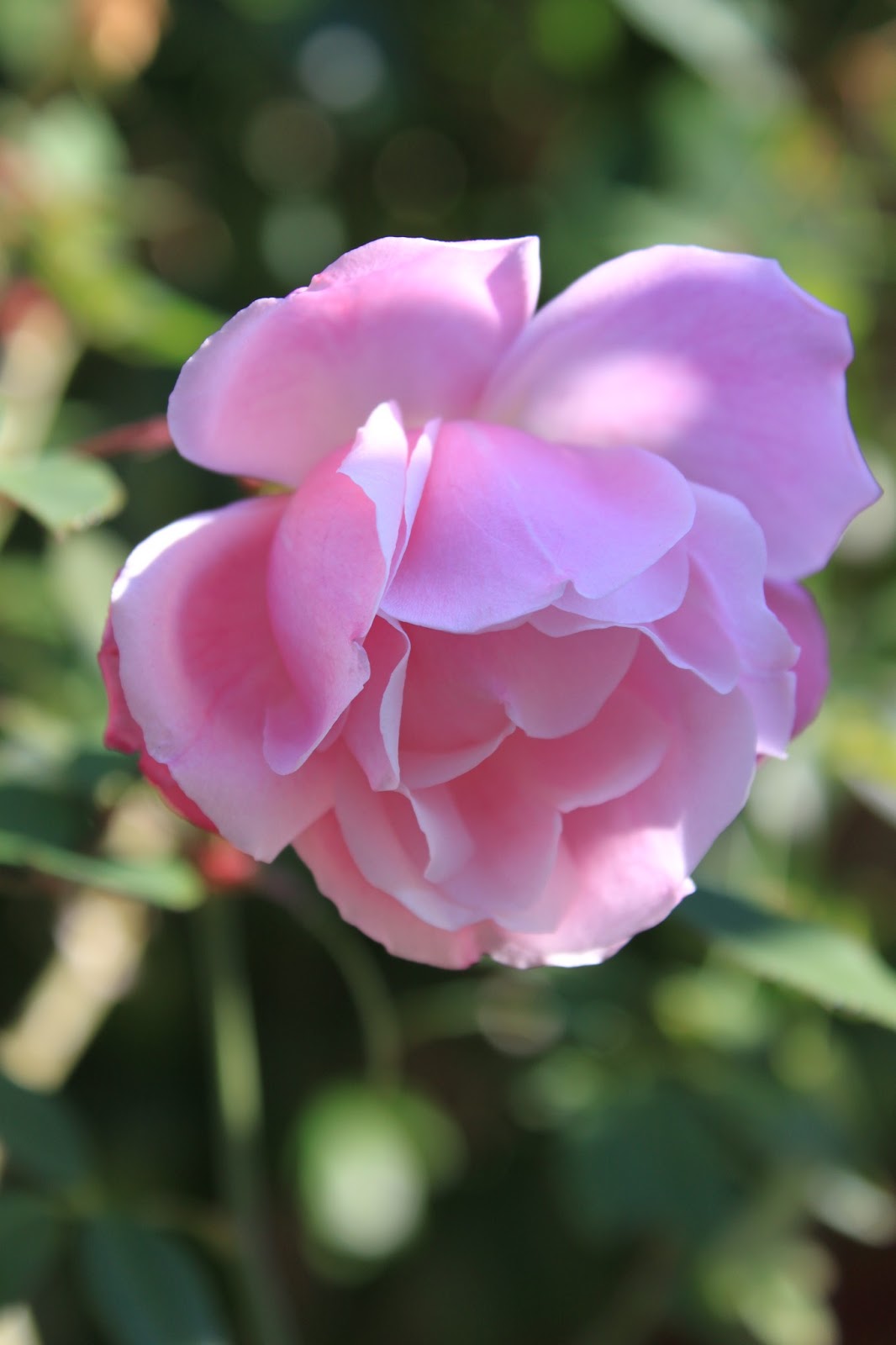
I had to share this with you. As I was grooming the pansies this past week inside the Welcome Center garden a lovely soft fragrance was drifting around my head. Pansies do have a sweet fragrance in mass, but this was different. And then I looked up and realized that it was the Rosa chinensis 'Old Blush' that had several flowers fully opened and sharing their loveliness. Not only does it smell great, it has the sweetest soft pink flowers that bloom and bloom and bloom.....even in January.
Is that not absolutely beautiful? And the fragrance is soft and fruity -- no need to stick your nose into the center, this fragrance comes to you.
'Old Blush' is one of the oldest roses around. It is also one of the first cultivars to come from Eastern Asia and reached Europe in the 1700's. First noted in Denmark in 1752 and then England in 1793.
The semi double flowers bloom continuously on a 5 foot bush -- living happily in zones 7-11 with minimal maintenance. It will make a lovely hedge or an outstanding specimen. This one is situated at the front of the garden where it gets some hours of direct sun and then partial shade in the late afternoon.
Stop by the garden if you are in town and enjoy this special rose. And while you are there, step to the other side and gently touch the leaves of Illicium floridana 'Pink Frost'.....it will give off its own sweet fragrance. While working under it to clean up that area, I had the pleasure of its company.
As the temperatures get colder, the white margins on 'Pink Frost' leaves will turn pink, matching the deep pink stems. In the spring it will put out red-maroon colored flowers -- not showy but an interesting addition to this shrub. It can grow 6-10 feet tall but responds well to pruning if you need to keep it in check. Zones 6-10 and shade tolerant. It has performed well for me in different situations and survived the benign neglect that I impose on plants that wait for their turn in the soil.
'Old Blush' may need to be ordered online but you can find 'Pink Frost' at independent nurseries. For locals, check with Thomas Orchards & Nursery in Bishop.
Is that not absolutely beautiful? And the fragrance is soft and fruity -- no need to stick your nose into the center, this fragrance comes to you.
'Old Blush' is one of the oldest roses around. It is also one of the first cultivars to come from Eastern Asia and reached Europe in the 1700's. First noted in Denmark in 1752 and then England in 1793.
The semi double flowers bloom continuously on a 5 foot bush -- living happily in zones 7-11 with minimal maintenance. It will make a lovely hedge or an outstanding specimen. This one is situated at the front of the garden where it gets some hours of direct sun and then partial shade in the late afternoon.
Stop by the garden if you are in town and enjoy this special rose. And while you are there, step to the other side and gently touch the leaves of Illicium floridana 'Pink Frost'.....it will give off its own sweet fragrance. While working under it to clean up that area, I had the pleasure of its company.
As the temperatures get colder, the white margins on 'Pink Frost' leaves will turn pink, matching the deep pink stems. In the spring it will put out red-maroon colored flowers -- not showy but an interesting addition to this shrub. It can grow 6-10 feet tall but responds well to pruning if you need to keep it in check. Zones 6-10 and shade tolerant. It has performed well for me in different situations and survived the benign neglect that I impose on plants that wait for their turn in the soil.
'Old Blush' may need to be ordered online but you can find 'Pink Frost' at independent nurseries. For locals, check with Thomas Orchards & Nursery in Bishop.
Tuesday, January 8, 2013
Little Leaves - Still a Big Impact
This is a side note before I start the blog. Actually, I started this blog a few days ago only to find out that I had a serious software glitch and could not upload my photos. Pure Panic!! I have to thank my dear friend, Carol Brown, for patiently holding my hand and helping me find a solution. Her patience with impatient people like me is incredible, her artistic and creative ability is sensitive and deep -- and last but not least, her technical savvy is amazing. She has a new blog that you really need to check out to see just how talented she is.....click on her site - Inspirational Nature -- which you can find here in the right-hand column. So back to the blog.........
In my last post I showed you pictures of the big leafed plants I've used in the containers. This time I wanted to share the fine leafed plants I used. What they lacked in leaf size they made up for in overall size and impact. I used two euphorbias this year -- a burgundy and a blue-green. My favorite of the two is probably Euphorbia martinii 'Rudolph' - and when you see the picture you will understand why it is called " Rudolph".
Does that not look like the red nose on Santa's Rudolph? Although when I see it in the container my first thought is fireworks. But whatever you choose to see, it makes an impact in the container. All euphorbias exude a milky sap when cut, which can irritate the skin and eyes so keep that in mind when pruning them. But they are so worth having.
Rudolph can grow to 24 inches tall
Happy in zones 6-9
Produces chartreuse green blooms in spring
The other euphorbia I used is Euphorbia wulfenii 'Shorty'....with soft blue leaves and soon to have bright yellow flowers. Notice in the photo the "nodding heads" of the upright branches, which indicates they are ready to strut their stuff.
This one is so easy to pair up with almost any color pansy or viola -- great with yellows, blues, reds....purples are better left to hang out with Rudolph. Check out the photo below of the "nodding head". If you look closely at the plants you might be able to see the flower buds tucked in the leaves.
A not so well known and little used plant that I really like for the winter arrangements is Erysimum variegated (there is also a cultivar called Bowles Mauve that has less variegation). The variegated leaves alone would create a bright spot in the container but then the lavender flowers are a pleasant surprise when they erupt.
18-24 inches tall
15-18 inches wide
Spring blooms attract butterflies
Needs full to partial sun
In anticipation of the heavy shade I'll have for a lot of the containers on Main Street where there are large trees, I've planted Autumn Ferns (Dryopteris erythrosora) -- my "go to" plant for shade. Since they are evergreen they do well in winter, experiencing only some leaf aging which can be clipped off. Come spring though they will reward you with awesome bronze colored new growth. A mature plant can easily reach 2' x 2'. Once it outgrows a container it is easily transplanted into the garden where it will thrive with little attention.
Here it is mixed in with Carex 'Ice Dance' -- a perfect companion. For that linear look 'Ice Dance' and Liriope 'Evergreen' are frequently used in my containers.
While all these plants are used in the container design, they will do equally, if not better, in your garden beds. Independent garden centers are your best bet for finding some of these, but the box stores will sometimes bring them in -- just be first in line when the truck arrives.
In my last post I showed you pictures of the big leafed plants I've used in the containers. This time I wanted to share the fine leafed plants I used. What they lacked in leaf size they made up for in overall size and impact. I used two euphorbias this year -- a burgundy and a blue-green. My favorite of the two is probably Euphorbia martinii 'Rudolph' - and when you see the picture you will understand why it is called " Rudolph".
Does that not look like the red nose on Santa's Rudolph? Although when I see it in the container my first thought is fireworks. But whatever you choose to see, it makes an impact in the container. All euphorbias exude a milky sap when cut, which can irritate the skin and eyes so keep that in mind when pruning them. But they are so worth having.
Rudolph can grow to 24 inches tall
Happy in zones 6-9
Produces chartreuse green blooms in spring
The other euphorbia I used is Euphorbia wulfenii 'Shorty'....with soft blue leaves and soon to have bright yellow flowers. Notice in the photo the "nodding heads" of the upright branches, which indicates they are ready to strut their stuff.
This one is so easy to pair up with almost any color pansy or viola -- great with yellows, blues, reds....purples are better left to hang out with Rudolph. Check out the photo below of the "nodding head". If you look closely at the plants you might be able to see the flower buds tucked in the leaves.
Shorty is true its name and grows only 12-17 inches tall. Perfect for that middle section of your garden or for a smaller container.
A not so well known and little used plant that I really like for the winter arrangements is Erysimum variegated (there is also a cultivar called Bowles Mauve that has less variegation). The variegated leaves alone would create a bright spot in the container but then the lavender flowers are a pleasant surprise when they erupt.
18-24 inches tall
15-18 inches wide
Spring blooms attract butterflies
Needs full to partial sun
In anticipation of the heavy shade I'll have for a lot of the containers on Main Street where there are large trees, I've planted Autumn Ferns (Dryopteris erythrosora) -- my "go to" plant for shade. Since they are evergreen they do well in winter, experiencing only some leaf aging which can be clipped off. Come spring though they will reward you with awesome bronze colored new growth. A mature plant can easily reach 2' x 2'. Once it outgrows a container it is easily transplanted into the garden where it will thrive with little attention.
Here it is mixed in with Carex 'Ice Dance' -- a perfect companion. For that linear look 'Ice Dance' and Liriope 'Evergreen' are frequently used in my containers.
While all these plants are used in the container design, they will do equally, if not better, in your garden beds. Independent garden centers are your best bet for finding some of these, but the box stores will sometimes bring them in -- just be first in line when the truck arrives.
Monday, December 31, 2012
Big Leaves - Big Impact
Forgot to mention that this shot was taken after I trimmed back half of it just to find the pansies. Not to worry that there will be no more leaves -- lots coming back in the center.
I think it is absolutely stunning close up. Just look at the texture of the crinkled leaf and then the striking contrast between the lime green of the veining and the burgundy of the leaf.
I feel in love with this mustard at Calloway Gardens. They had created a huge bed with 'Red Giant' as the back drop and burgundy and yellow pansies in front.
With just an occasional trimming you can keep this gentle giant in check and get all the benefits.
My next favorite is the 'Lacinato' Kale. What a work horse it is. And you don't usually get this blue coloring in winter. This is Container 7 outside the Welcome Center which gets different lighting than Container 10, located on the corner of Main and Washington.
Notice the difference in growth habit. Container 10 is shorter and tighter. Then look at the heavy crinkled surface in the following picture. The light green viens also give you another color aspect to tie into your containers.
Two of my other favorite kales that provide lots of texture are 'Starbor' Kale and 'Red Russian' Kale.
And last, but not least by any means, is the 'Starbor' Kale. This one might just win the "over the top" texture contest.
A single leave is exciting -- but a bunch is a "wow" factor.
There are lots of other kales and mustards on the market -- I've just found these to be proven winners every year. And if you don't use pesticides in your garden -- you can even eat these!!!
Tuesday, December 18, 2012
Blue Crisp Fern Hanging In There
I told you early in the season that I loved the Blue Crisp Fern. It is big, bold and bodacious and now it looks like it is also tenacious. I intentionally left this "tropical fern" in a container to see when it would finally give up -- what low temperature would take it away. Well, we've had low 30's in Madison many days and it still looks great......
.....but I do have to say that this container is situated on a busy street with lots of traffic and surrounded by brick buildings, so there is a microclimate created that probably offers warmer temperatures. Stay tuned to see how it fares the remainder of the winter.
Also had to show you the heuchera that is in with the fern. 'Golden Zebra' is truly showing its "stripes" on the side that gets more sun.
.....but I do have to say that this container is situated on a busy street with lots of traffic and surrounded by brick buildings, so there is a microclimate created that probably offers warmer temperatures. Stay tuned to see how it fares the remainder of the winter.
Also had to show you the heuchera that is in with the fern. 'Golden Zebra' is truly showing its "stripes" on the side that gets more sun.
Now look at the one which gets total shade.....
Still pretty but not as vibrant.
The Golden Zebra heuchera will definitely be part of another season's containers since it is a perennial -- but I'm counting on Blue Crisp Fern to be part of them also -- we'll see.
Friday, November 30, 2012
More "Children" and they are getting bigger
In my last blog I told you that I would be doing the "giants" on the corner of Washington and Second Street. Well, they are done!! And so we now have 42 middle sized children, 4 baby sized children (urns inside the Park) and 6 "giant" sized children....for a total of 52 containers! Madison is just getting prettier by the day. Now that I'm done planting I can finally update that map.
But I wanted to share with you what I put in those gentle giants. Took a lot of stuff to fill them -- they look good now so I can't wait to see them when they are fully grown out. Of course, there are pansies, violas and kale, but to add some height in the middle I used a conifer. Juniper communis 'Gold Cone' is in the shorter container. It can tolerate the heat and drier conditions we are going to throw at it; and this variety won't get but about 18-24" wide so it won't overwhelm the pot. New growth is yellow while fall color turns a slight shade of blue.
The grass in the back container is a panicum -- a wonderful perennial grass. Its winter look goes well with the juniper so I left it. In the spring we'll cut it back and let the pretty blue blades stand proud.
Since yellow is one of the traffic stopping colors I used it as my main theme, adding purple as the accent. Here is what I planted:
Delta Premium Pure Yellow -- a bright yellow face that will companion with just about any other color.
The viola I used with it is Sorbet Sunny Royale (above). There is enough purple to give contrast but also enough yellow to stand out. I didn't get a close up of the kale that I used in both containers but it is Winterbor -- its ruffled leaf edges gives the container some movement. These are all in the shorter container. In the tall on in the background I used ---
Dynamite Blue Jeans....it practically glows (forgive the picture -- it was another windy day). It is paired with the Delta Pure Yellow and, one of my favorite violas, Sorbet Yellow Chiffon, a non-stop bloomer -- pictured below.
Violas are tough and bloom heavily, so if the pansies need to take a break there will still be lots of color. Now that there are flowers in these pots maybe folks will stop using them as giant trash cans -- we can only hope.
Subscribe to:
Posts (Atom)